|
Old photo of Steep Hill in
Widow Cullen's Well |
The modern city of Lincoln is dramatically divided into top and bottom towns, joined by the very aptly-named Steep Hill. The original Roman settlement of Lindum Colonia was built by retired soldiers (as the name Colonia suggests) who received a pension and a grant of land to settle there. It was at the top of the hill on the site of the current castle.
Excavations at the castle have revealed remains of several houses on the site, including a beautiful mosaic that was wrecked by Victorian workmen during demolition of the old gaol. Other Roman artefacts are on show at the newly refurbished castle museum.
You can encounter bits of Roman Lincoln all over the city and according to a photo on show in Widow Cullen's Well (It's a pub!) there's part of an old gateway set into the wall of two shops on Steep Hill.
Other remains are quite well hidden. Down a very narrow street called East Bight are the remains of a water reservoir, built on the inside of the northern defensive wall. One wall of the tank still exists in a back garden. Its foundations are about 16 feet deep and it was lined with waterproof cement. Its capacity has been estimated at 2,660 gallons, so was probably one of several around the town. This reservoir probably helped serve the baths complex, which was nearby.
 |
| The remains of the water tank |
In common with modern services suppliers, the Roman authorities were faced with a problem of how to get a water supply to the top of a very steep hill. They built an aqueduct at least a mile long from a spring called Roaring Meg but were then faced with the challenge of raising the supply to the city, 100 feet higher. No evidence for a mechanism has been found, but there must have been some sort of bucket arrangement to lift the water onto the aqueduct so it could run to the town. However, archaeologists have shown that there are no lime deposits in the clay pipe along the aqueduct, so perhaps the system was less than effective.
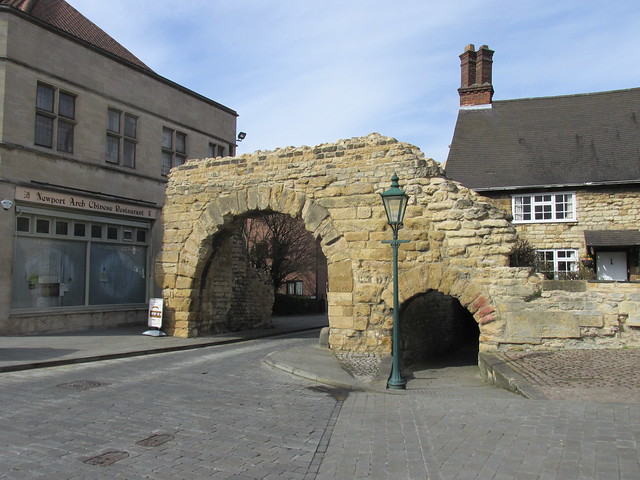 |
| Newport Arch - still in use today |
The East Gate of the Roman walls of Lindum Colonia was the grandest of the entryways into the city. It began as a simple wooden structure, however, constructed in around 60 AD. It developed over the next hundred or so years until it became an impressive two-storey, double-towered building with two arched gateways. It remained in use well after the Romans left but only the foundations now exist in the street that bears its name: Eastgate.
The only surviving Roman arch in the UK that is still used by traffic is across the old road of Ermine Street, now known as Newport. Its survival is impressive, given that it has been attacked many times: in the 13th century by medieval knights laying siege to the town and in the 20th century by a delivery lorry from Humberside! (Though never in the Roman period.) It's now reinforced with steel rods to protect it from traffic vibrations.
It is believed to have been built when the northern defensive wall was strengthened in the 4th century, by which time Lindum Colonia had grown in importance and served as a provincial capital. Originally the gate would have had a pedestrian arch at both sides and would have been two storeys high.
Lincoln's Roman remains are not as complete as those of York or Chester, but somehow they are more personal, more relevant to a modern observer. Well that's how I feel about them anyway. Of course I'm biased. Years ago I used to live just beyond Newport Arch and walked under it every day on my way to work. I also drove under it on my driving test. Makes me wonder now how I passed.