The History Anorak

The History Anorak
Showing posts with label Richard III. Show all posts

Thursday, 28 September 2017

Richard III

     I, that am curtailed of this fair proportion,
     Cheated of feature by dissembling nature,
     Deformed, unfinished, sent before my time
     Into this breathing world, scarce half made up
            Shakespeare
            Richard III Act1 Scene 1

Statue by the Cathedral
I'm going to let you into a secret dear Reader: I share something with Richard III. No, I didn't spend the last 500 years under a car park in Leicester, I am, like him, "deformed, unfinished ......scarce half made up". Yep, I have scoliosis. My spine is curved. Or in other words I'm a hunchback.

It means I've always had a soft spot for the much-maligned king.  I never believed that he had the Princes in the Tower murdered (though I'd be prepared to believe that someone did it thinking they were doing him a favour); I always hoped that one day I'd learn something positive about him.

And that's where the latest day out comes in. I decided to visit Richard in his adopted home of Leicester. Of course it was never his idea to adopt Leicester. He didn't set out on 22 August 1485 to lose the Battle of Bosworth and so, by a convoluted route, end up under a city centre car park.  He always said he wanted to be buried in York, but when the fight to provide his final resting place ended York Minster came in second.

The car park
This, as Sellar and Yeatman would say, is A Good Thing. York didn't really need an additional tourist attraction. Leicester has done him proud. I regret to say that my photos of his tomb came out very badly blurred so I can't show you the views I'd like. I plan to return to get better shots.

Richard turned up in a car park on the site of the old Franciscan priory (Greyfriars) which, these days, is opposite the Cathedral. (That's quite likely, when you think about it.) After the scientists finished doing all their DNA tests and the rest of the investigations they subjected him to, he was re-interred in the Cathedral. The site opposite, where he was found, is now the Richard III visitor centre.

It covers his family history, the background to the Wars of the Roses (in which the House of Lancaster and Richard's House of York argued over who was the rightful King), the lead up to the Battle of Bosworth, and the treachery of the Stanley family who brought their forces to the battlefield then held back to see which side was winning before they joined in!
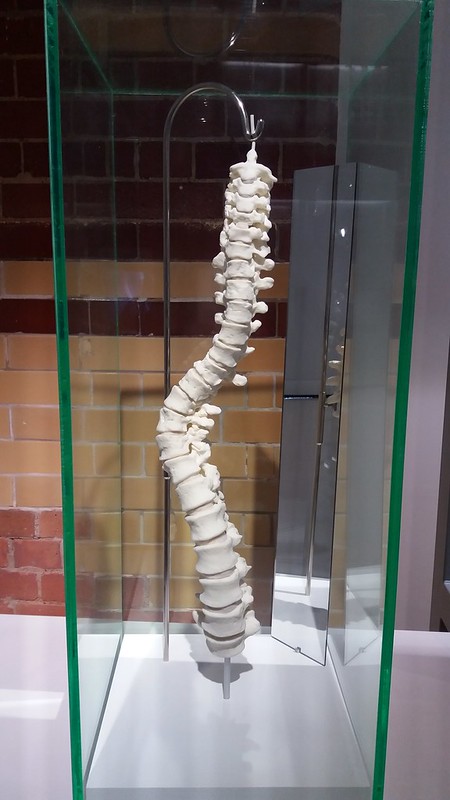
Model of Richard's spine
However, it was the upper floor that had most effect on me, where the topic of Richard's shape is discussed. We're all familiar with Shakespeare's version of Richard's story. He's portrayed as an ugly, misshapen and evil man who will stop at nothing to get his own way,  Now the Tudors (who gained the throne after victory at Bosworth) believed that deformity and disability were linked to moral weakness. In other words, the more twisted Richard's body, the worse his character. Shakespeare, who relied on Tudor patronage, exaggerated the deformity to make Richard seem more unworthy of the throne.

Will also lied about a few other things: that famous quote about offering his kingdom for a horse, for example. The implication is that he wanted means to escape, but contemporary reports say he went down fighting and determined not to yield a yard of ground.  The archaeological evidence supports that. Richard died from multiple head injuries caused by a number of different weapons.

In fact much of what we learned about Richard at school conflicts with the truth. Contemporary reports of the man suggest he was, in fact, a fine and respected King. Like this one on the wall of the visitor centre:


Links
King Richard III Visitor Centre
Putting a face to Richard


Saturday, 10 June 2017

Kirby Muxloe

William Hastings was Edward IV's lord chamberlain and made a small fortune in the post. As a result he could afford to build himself a luxury home on the family estates in Leicestershire.

Hastings chose a plot of land at Kirby Muxloe where the family already had a manor house. The new fortified house was built entirely out of brick, an expensive and fashionable material only recently introduced to England. Hastings brought craftsmen from the Netherlands to make the bricks on site because too few people here knew the skill.

However, the house was never completed because Hastings fell foul of the ambitious Duke of Gloucester, later to be Richard III, who accused him of conspiracy and had him executed in 1483.

The land remained in the family's possession until 1630, but only one tower was ever finished, although it's still possible to see how impressive the house would have been. Most of what remains today is footings for the outer walls, but the gatehouse stands proudly to welcome you on site.

Although it was also never finished, the gatehouse shows how well designed the building was. You can still pick out the pattern of dark bricks (known as diaper work) on the frontage.

In addition the castle had gun ports and a moat to aid its defence.

Saturday, 13 August 2016

Who slept here?

Miles out in the wilds of Leicestershire, close to Coalville, is a lovely little village called Donington le Heath and the delightful manor house has recently undergone a transformation to turn it into The 1620s House. It has a pretty little garden (I'll return to that in a later post.) and a collection of authentic, but not necessarily original, furniture from the early 17th century.

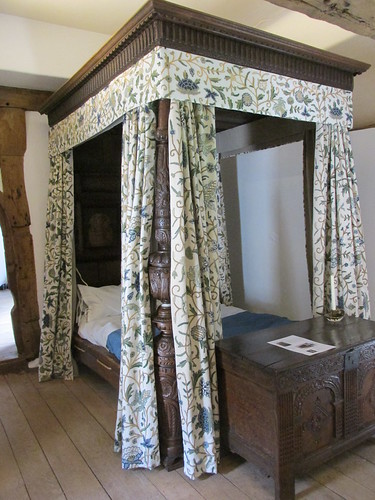
This fine piece is known as King Dick's bed. It was brought to Donington from Leicester, where it stood for many years in the Blue Boar Inn. According to its previous owners it's the bed that Richard III slept in on the eve of the Battle of Bosworth. (Where he died for want of a horse and ended up buried under a council car park.) However, it's just the base and the rope supports that might have even a distant connection to the king. The canopy and tester all date from the mid 17th century. (And the curtains are only a couple of years old.)

Beds like this pre-date spring mattresses, of course, and bedding was supported on a web of ropes that could be adjusted by pulling hard on them from the sides. (You can see the loops in the photo.) This is supposedly the explanation of the expression "sleep tight".