

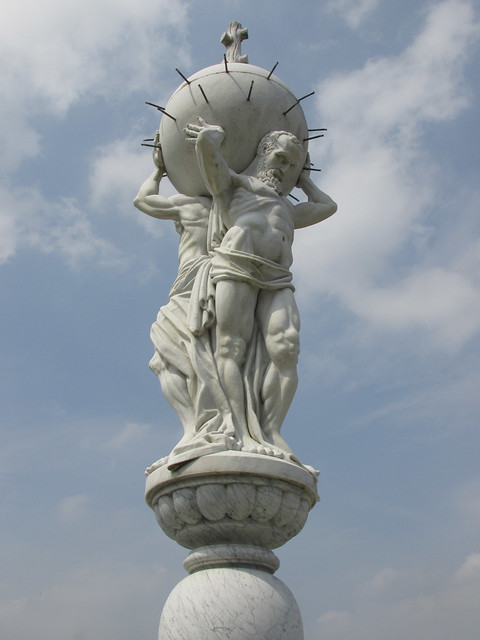
That letter has formed the basis of a reconstruction carried out by English Heritage, backed up by archaeological excavation, and painstaking historical research. The geometric knot garden outlines have been recreated. The beds have been replanted with herbs, flowers and trees that are accurate to the period. And the whole thing has been adorned with statuary, obelisks, topiary and gravel paths, as it would have been at the time.
As Langham described it:
A garden then so appointed, as wherein aloft upon sweet shadowed walk of terrace, in heat of summer, to feel the pleasant whisking wind above, or delectable coolness of the fountain-spring beneath, to taste of delicious strawberries, cherries, and other fruits, even from their stalks, to smell such fragrancy of sweet odours, breathing from the plants, herbs, and flowers, to hear such natural melodious music and tunes of birds, to have in eye for mirth sometime these underspringing streams, then, the woods, the waters (for both pool and chase were hard at hand in sight), the deer, the people (that out of the east arbour in the base Court, also at hand in view), the fruit-trees, the plants, the herbs, the flowers, the change in colours, the birds flittering, the fountain streaming, the fish swimming, all in such delectable variety, order, and dignity; whereby, at one moment, in one place, at hand, without travel, to have so full fruition of so many God’s blessings, by entire delight unto all senses (if all can take) at once.
The garden is believed to be the finest example of Elizabethan style in the country.

Dudley was a close companion of the Queen and probably would have married her, were it not for the fact that he already had a wife. Conveniently, Amy Robsart fell down a flight of stairs and died from a broken neck, but it was widely rumoured that she didn't so much fall, as succumb to a hand in the back! Dudley wasn't there at the time but, being the politically aware character that she was, Elizabeth probably avoided marrying him as a result. Nevertheless, Dudley remained a powerful figure at court and held many significant titles during his lifetime.
When Elizabeth fell ill in 1562 she appointed him Protector of the Realm, but she recovered, much to the relief of other courtiers. He was already Master of the Horse, Knight of the Garter, Privy Councillor and Lord Steward of the Royal Household.
