Imagine you're a 17th century toff and you want an uninterrupted view of your grazing herds over in the park, but you don't want the beastly animals trampling your manicured lawn. Well, have no fear your lordship. There's a newfangled design just been brought across from France that will solve your problem in one simple move.
The idea is that you dig a ditch around the boundary of the lawn. The far side slopes gently, so as the cows won't break their legs by falling in, but this side is a sharp drop, supported by a wall. Of course, some of your lordship's children might run off the end of it, and perhaps a couple of the servants, but all-in-all it'll be better than a dirty great fence across the vista, won't it?
Monsieur Guillaume Beaumont (known to his mates as Bill) created one for Levens Hall up in Cumbria. They're laying out new gardens and he put one in right from the start when he began planning in 1694. They say he's the first to have done it in this country.
And back to the present day......
The innovative structure is today known as a ha-ha, believed to have earned its name from people coming across it unexpectedly in the landscape. One of its keenest users was Lancelot "Capability" Brown (1716-83), because it helped him create truly bucolic scenes without the need for walls and fences, but obviously that was some time later than Levens, owing to the fact that he wasn't born till 1716.
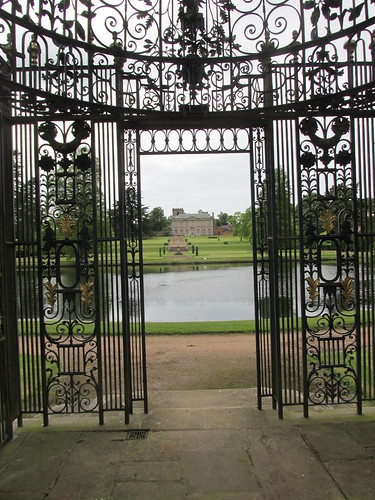
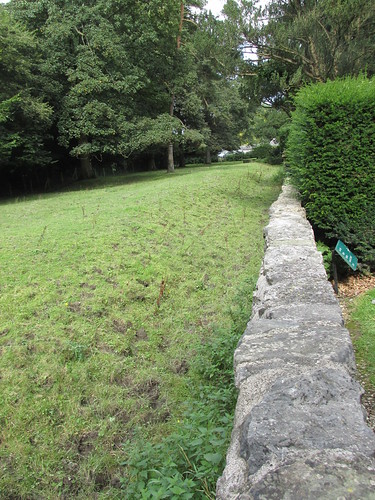
The top photo is the view along the ha-ha, but it's not easy to understand immediately. The wall is at ground level. You are standing to the right of it. It might not be obvious but the grass on your left slopes down towards you. You can see the angle if you look into the distance in the pic. Please excuse the photo because I get nervous when I'm balancing on the edge of a six foot drop. The darker green you can see by the wall is a nettle bed - just to add to the fun.
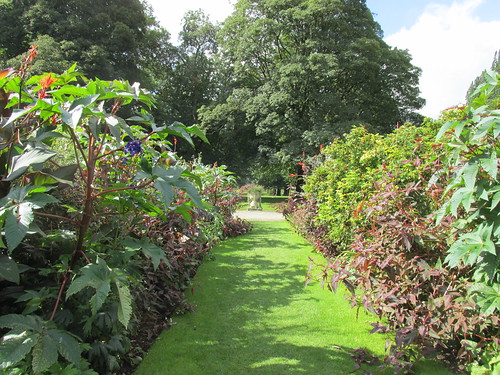
So that brings us to photo 2, which shows the effect of having a ha-ha. The trees in the distance are the ones you can see on the left in photo 1. What you can't see in either photo is the fact that there are cows out there too. They are free to roam where they wish, but they can't get up and over the ha-ha wall to trample your lovely herbaceous borders. In fact, the ditch is so deep that you wouldn't be able to see the cows, even if they were right up against the wall.
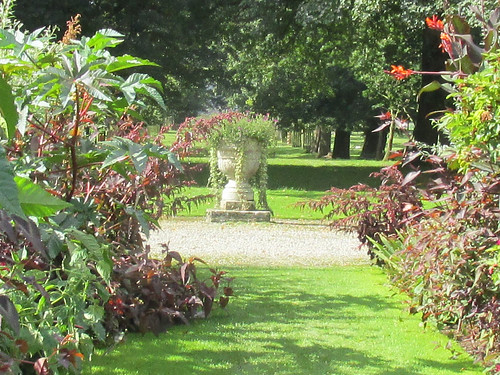
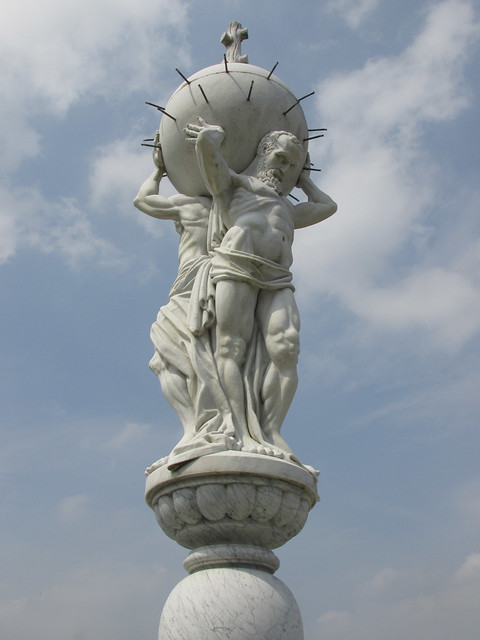
And this last photo is a closer view of the urn that you're supposed to see in the view. It's a typical decorative feature of the time. Gardens around this date often had long views between flower beds, or hedges, with a classical urn or statue acting as a focal point at the end.
The shadow is, of course, where the ditch is. The fact that you can see it is entirely due to the direction of the sun when this photo was taken. Normally it would just be green, as far as your eye could see. Ha-ha!
Showing posts with label garden history. Show all posts
Saturday, 8 October 2016
Friday, 16 September 2016
Garden features: topiary
![]() |
| Topiary at Levens Hall |
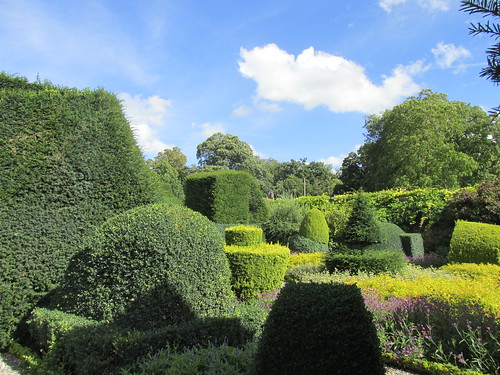
One of the most important topiary gardens in the UK is at Levens Hall in Cumbria. The garden was first laid out in the 1690s and has changed very little since. It is believed that some of the trees there are from the original planting. It was designed by Guillaume Beaumont, believed to have trained under Le Notre at Versailles, and one time gardener to James II.
![]() |
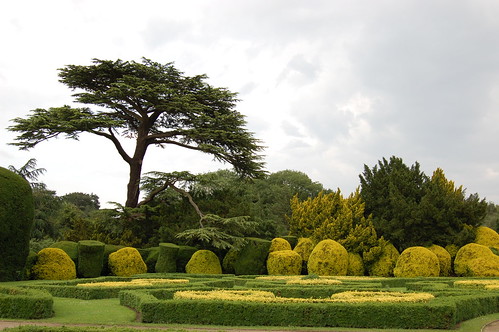
| Victorian taste at Elvaston Castle |
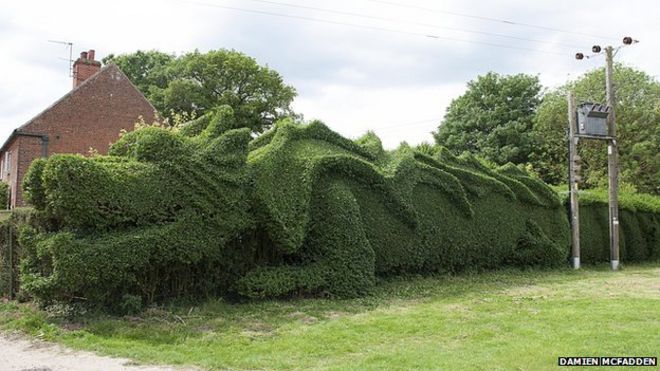
Today topiary is mainly restricted to a few extremely elaborate structures in smaller gardens, designed to create one showpiece, rather than a large display.
![]() |
| A modern example (Not my photo. Used with thanks.) |
Monday, 29 August 2016
Garden features: stumperies
![]() |
| Entering the stumpery at Biddulph |
Tree stumps and root systems, often collected from land clearance across a country estate, are piled up, or set into a wall, and secured with posts and metalwork to create an unusual, often unearthly, but effectively natural, structure.
The idea behind a stumpery is to create an attractive backdrop for greenery, and they are usually the home of ferns, mosses and lichens. They rose to fashion at the same time as ferns were being introduced into English gardens, around the era of the Romantic Movement - the 'natural' backlash to the Industrial Revolution. Coincidentally they are also great places for wildlife, because the rotting wood attracts various insects, which attracts birds and small mammals, and so on.
![]() |
| More ferny stumps |
If you fancy creating one in your own garden it's extremely possible and there are plenty of DIY helpers online. They suggest you can even use old railway sleepers if you can't get hold of dead tree roots. But wouldn't that be a sleepery?
References
https://en.wikipedia.org/wiki/Stumpery
https://parksandgardensuk.wordpress.com/2015/05/02/stumperies/
Wednesday, 24 August 2016
Baboon
You can find some strange things in people's gardens. Mind you, the gardens at Biddulph Grange are quite strange in themselves. They were originally designed to hold the collections of renowned plantsman James Bateman (1811–1897), who owned the property. They were drawn up with the help of seascape artist Edward William Cooke, which might explain their completely unpredictable nature.
The grounds are divided into many sections that represent different species or even different areas of the world. The two most well known are China and Egypt. When you've paid your National Trust entrance fee you're handed a map and waved off on a voyage of exploration. Other than "this way to the tea shop" and "you can buy plants here" you'll find very little signage - so you're on your own - and you'll be passed many times by visitors who have their heads facing down to a rather bedraggled piece of paper, wandering endlessly and muttering "I know China's around here somewhere" or "I think it's supposed to be near Egypt". Meanwhile they're missing the magnificent dahlias and the unearthly 'stumpery' or the very tall trees in the pinetum.
We can be sympathetic. Each of the miniature gardens is well hidden behind intervening rockeries, banks of topiary, or a myriad other kinds of feature that obscure, entrance, and otherwise distract from the original destination.
But I digress. I was planning to discuss the oddest thing (well - I thought it the oddest) to be found in the gardens, and that's a rather squat statue of a baboon that sits hunched inside the dark catacomb of a replica tomb in the Egypt garden.
Hamadryas baboons (Papio hamadryas) held a significant place in Egyptian society. They were often kept as pets, and there's some evidence that they could be trained to pick fruit, such as figs. This is gleaned from tomb paintings, so it's a matter of interpretation, but it's not unlikely. Since the earliest, pre-dynastic, era they were considered sacred and the god Baba might be how they came to get their name. They were admired for their intelligence and their lustfulness. I'm not sure I wanted to know that their faeces was used in aphrodisiac potions. (These Egyptians wrote everything inside their tombs because they needed all the trappings of life to survive on the 'other side'.) By the time of the Old Kingdom baboons were associated with the god Thoth, who controlled wisdom, science and measurement.
So it's not odd in itself that there's a baboon in the Egypt garden, but it's not the first Egyptian god that springs to mind. He sits in an alcove underground (I had to use a flash to get a decent photo.) with just a red skylight over his head to crack the darkness. A lot of people walked straight past him without noticing.
That's all of Biddulph I'm giving you for now. I might eke out its wonders over a few posts, because there's a lot of it.
References
Wikipedia (https://en.wikipedia.org/wiki/Biddulph_Grange) and Ancient Egypt: the mythology (http://www.egyptianmyths.net/baboon.htm) for supporting information.
The grounds are divided into many sections that represent different species or even different areas of the world. The two most well known are China and Egypt. When you've paid your National Trust entrance fee you're handed a map and waved off on a voyage of exploration. Other than "this way to the tea shop" and "you can buy plants here" you'll find very little signage - so you're on your own - and you'll be passed many times by visitors who have their heads facing down to a rather bedraggled piece of paper, wandering endlessly and muttering "I know China's around here somewhere" or "I think it's supposed to be near Egypt". Meanwhile they're missing the magnificent dahlias and the unearthly 'stumpery' or the very tall trees in the pinetum.
We can be sympathetic. Each of the miniature gardens is well hidden behind intervening rockeries, banks of topiary, or a myriad other kinds of feature that obscure, entrance, and otherwise distract from the original destination.
But I digress. I was planning to discuss the oddest thing (well - I thought it the oddest) to be found in the gardens, and that's a rather squat statue of a baboon that sits hunched inside the dark catacomb of a replica tomb in the Egypt garden.
Hamadryas baboons (Papio hamadryas) held a significant place in Egyptian society. They were often kept as pets, and there's some evidence that they could be trained to pick fruit, such as figs. This is gleaned from tomb paintings, so it's a matter of interpretation, but it's not unlikely. Since the earliest, pre-dynastic, era they were considered sacred and the god Baba might be how they came to get their name. They were admired for their intelligence and their lustfulness. I'm not sure I wanted to know that their faeces was used in aphrodisiac potions. (These Egyptians wrote everything inside their tombs because they needed all the trappings of life to survive on the 'other side'.) By the time of the Old Kingdom baboons were associated with the god Thoth, who controlled wisdom, science and measurement.
So it's not odd in itself that there's a baboon in the Egypt garden, but it's not the first Egyptian god that springs to mind. He sits in an alcove underground (I had to use a flash to get a decent photo.) with just a red skylight over his head to crack the darkness. A lot of people walked straight past him without noticing.
That's all of Biddulph I'm giving you for now. I might eke out its wonders over a few posts, because there's a lot of it.
References
Wikipedia (https://en.wikipedia.org/wiki/Biddulph_Grange) and Ancient Egypt: the mythology (http://www.egyptianmyths.net/baboon.htm) for supporting information.
Wednesday, 27 July 2016
Kirby Hall Gardens
Kirby Hall was an Elizabethan show house, designed with the aim of attracting the attention of the monarch. Sadly, the Virgin Queen never visited, in spite of the efforts of two consecutive owners Sir Humphrey Stafford and Sir Christopher Hatton. The Hall passed through the hands of various members of the Hatton family and it is believed that Sir Christopher I's cousin (Sir Christopher II) laid out the original great garden alongside the house. However, it is his grandson (Sir Christopher IV) who indulged his interest in plants and developed the grounds into what became known as ‘the finest garden in England’.
That garden has been recreated by English Heritage, the current custodians of the property, but between the time of Sir Chris IV (1685 and beyond) and the 1930s, when the site was taken into state guardianship, it fell into disrepair, and eventually disappeared.
But in the 1980s English Heritage began an archaeological investigation under the leadership of garden historian Brian Dix. The team gathered as many clues as possible to the garden's original layout, for example considering the colours and texture of soil across the site. During the excavations a spread of bent nails was found, indicating the positions of boards used to create the geometric patterns of the lawns and paths. Coupled with written texts, the evidence allowed developers to recreate the Great Garden as closely as possible to how it would have been in the 1690s.
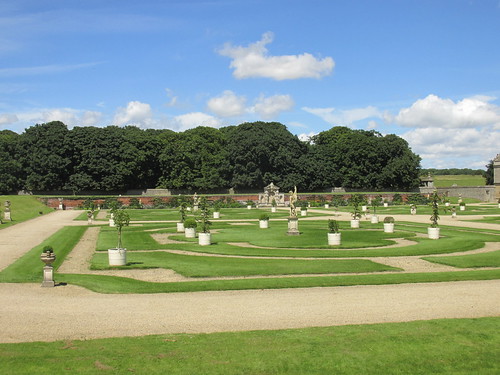
The garden is a fine example of 'cutwork', which consists of carefully manicured lawns separated by coloured gravel walkways. It is divided into four quarters or parterres. (From the French 'on the ground'.) The symmetrically-laid patterns of curves and straight lines reflect the symmetry of the house. In contrast to the pattern on the floor there are carefully positioned statues, urns, seating, topiary and other features to give height to the composition.
The overall pattern was designed to be viewed from above and to the South end there is a grassy mount, where visitors could walk to the summit and look down on the garden. To the North is a red brick wall where a floral border incorporates flowers and plants typical of the era, including fruit trees trained along the brickwork to maximise the light they receive.
Originally, beyond the mount was an area called the Wilderness. It was a heavily-planted area with trees and many, intersecting paths where visitors could stroll. It's not a wilderness in the current sense, rather a place to wander and to be offered many choices of direction, from the old English verb 'to wilder', which is also the stem of the word 'bewilder'.
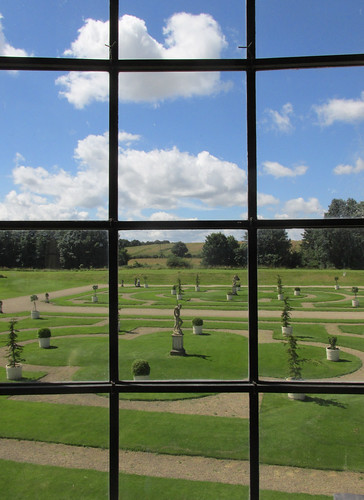
In the late 17th century a garden was a definite status symbol and only a chosen few would have been invited to see it; but the design and planting were aimed at impressing them. Tantalising glimpses could be seen from the state rooms, so even those who were not escorted around the garden and shown the latest new species to be planted there would be well aware of its owner's importance.
That garden has been recreated by English Heritage, the current custodians of the property, but between the time of Sir Chris IV (1685 and beyond) and the 1930s, when the site was taken into state guardianship, it fell into disrepair, and eventually disappeared.
![]() |
| The view from the state rooms |
But in the 1980s English Heritage began an archaeological investigation under the leadership of garden historian Brian Dix. The team gathered as many clues as possible to the garden's original layout, for example considering the colours and texture of soil across the site. During the excavations a spread of bent nails was found, indicating the positions of boards used to create the geometric patterns of the lawns and paths. Coupled with written texts, the evidence allowed developers to recreate the Great Garden as closely as possible to how it would have been in the 1690s.
![]() |
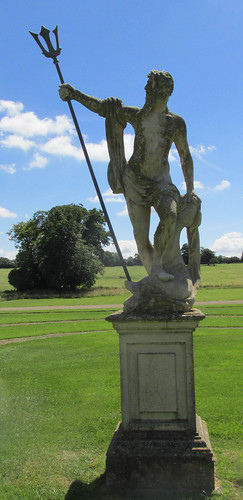
| Statue of Neptune |
The garden is a fine example of 'cutwork', which consists of carefully manicured lawns separated by coloured gravel walkways. It is divided into four quarters or parterres. (From the French 'on the ground'.) The symmetrically-laid patterns of curves and straight lines reflect the symmetry of the house. In contrast to the pattern on the floor there are carefully positioned statues, urns, seating, topiary and other features to give height to the composition.
![]() |
| The mount |
![]() |
| The view from the mount |
In the late 17th century a garden was a definite status symbol and only a chosen few would have been invited to see it; but the design and planting were aimed at impressing them. Tantalising glimpses could be seen from the state rooms, so even those who were not escorted around the garden and shown the latest new species to be planted there would be well aware of its owner's importance.
Sunday, 10 July 2016
Birdcage
![]() |
| The Birdcage Arbour |
One of the reasons so few people have heard of it is because it's not open very often. Weekends and Wednesdays, April to September, with occasional extra days in August. and then only for four hours at a time. I live five miles from it and it's taken me 10 years to get there. I tried a few weeks ago but there was a blackboard at the entrance with "Gardens closed. Flood." chalked on it. Second attempt was more successful.
For anyone who bothers to check, Melbourne Hall has one of the most unspoiled gardens of its era - the very early 18th century. The original design was drawn up in 1704, but it was already becoming out of date by the time it was finished a couple of decades later. The likes of Lancelot "Capability" Brown and his ilk were doing away with the French style of geometric ponds, regimented lawns, classical statuary and long vistas by the 1730s, to make way for a more 'natural look'. (Of course their kind of nature frequently required re-routing streams and rivers, and the removal of whole villages if they spoiled the view. A most unnatural form of nature.)
![]() |
| Looking up through the dome |
![]() |
| The view back to the house |
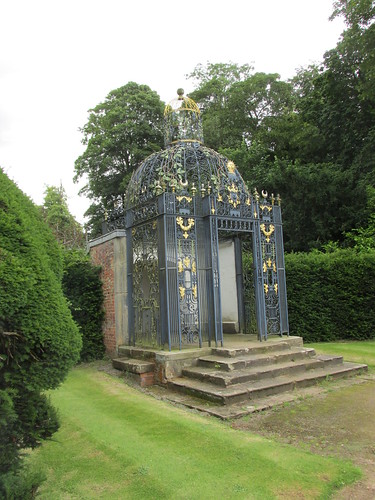
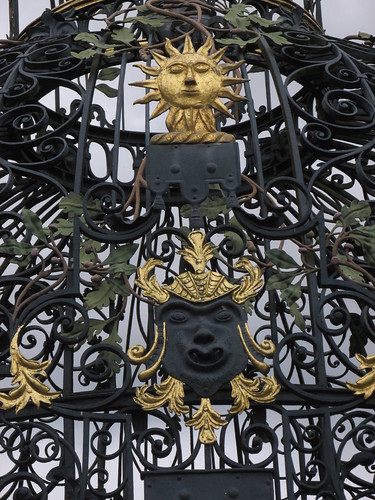
It's packed full of statuary, almost all of which is listed Grade I, but its crowning glory is undoubtedly its Birdcage Arbour, which stands by the pond at the southern end of the garden. It's exquisite. It was designed and built by local blacksmith Robert Bakewell and is extremely ornate wrought iron, topped with a cupola rising to a tall finial. It is decorated with leaves and scrolls, caricature faces and sun disks. Bakewell was paid the then princely sum of £120 for his work, but its production left him penniless. However, it vastly increased his reputation and he managed to find other work in and around Derbyshire, including the chancel screens at Derby cathedral and Staunton Harold church.
And how did Melbourne pass on its name to the Down Under town?
Well, in the mid 19th century it was the home of William Lamb, 2nd Viscount Melbourne and Prime Minister of the UK. It was named in 1837 by Governor Sir Richard Bourke to honour him. Clearly the scandal caused by his wife Lady Caroline's affair with the poet Byron in 1812 had been forgotten by that time. A week is a long time in politics, as they say. Twenty five years is obviously even longer!
Monday, 9 May 2016
Garden of Love
In 1575 Robert Dudley, Earl of Leicester was expecting a visit from his queen Elizabeth I at his home, Kenilworth Castle in Warwickshire. To honour her he chose to create a garden - the finest of its kind. The garden was private; never intended for any eyes except the queen, Dudley and his closest companions. But by chance one of the household, a minor clerk by the name of Robert Langham, was shown round the site by a gardener. Langham then wrote a letter to a friend describing the wonders he had seen.
That letter has formed the basis of a reconstruction carried out by English Heritage, backed up by archaeological excavation, and painstaking historical research. The geometric knot garden outlines have been recreated. The beds have been replanted with herbs, flowers and trees that are accurate to the period. And the whole thing has been adorned with statuary, obelisks, topiary and gravel paths, as it would have been at the time.
At the centre is an 18 foot high carrara marble fountain in an octagonal basin, and to one side stands an ornate aviary alive with chirping, brightly-coloured finches. On the opposite side is a steep bank, up to a viewing terrace flanked by rose arbours. It is beautiful, and blissfully quiet for the most time, given that the majority of the world, his wife and kids, spend their time exploring the castle and giving the gardens less than a cursory glance.
As Langham described it:
A garden then so appointed, as wherein aloft upon sweet shadowed walk of terrace, in heat of summer, to feel the pleasant whisking wind above, or delectable coolness of the fountain-spring beneath, to taste of delicious strawberries, cherries, and other fruits, even from their stalks, to smell such fragrancy of sweet odours, breathing from the plants, herbs, and flowers, to hear such natural melodious music and tunes of birds, to have in eye for mirth sometime these underspringing streams, then, the woods, the waters (for both pool and chase were hard at hand in sight), the deer, the people (that out of the east arbour in the base Court, also at hand in view), the fruit-trees, the plants, the herbs, the flowers, the change in colours, the birds flittering, the fountain streaming, the fish swimming, all in such delectable variety, order, and dignity; whereby, at one moment, in one place, at hand, without travel, to have so full fruition of so many God’s blessings, by entire delight unto all senses (if all can take) at once.
The garden is believed to be the finest example of Elizabethan style in the country.
Dudley was a close companion of the Queen and probably would have married her, were it not for the fact that he already had a wife. Conveniently, Amy Robsart fell down a flight of stairs and died from a broken neck, but it was widely rumoured that she didn't so much fall, as succumb to a hand in the back! Dudley wasn't there at the time but, being the politically aware character that she was, Elizabeth probably avoided marrying him as a result. Nevertheless, Dudley remained a powerful figure at court and held many significant titles during his lifetime.
When Elizabeth fell ill in 1562 she appointed him Protector of the Realm, but she recovered, much to the relief of other courtiers. He was already Master of the Horse, Knight of the Garter, Privy Councillor and Lord Steward of the Royal Household.
That letter has formed the basis of a reconstruction carried out by English Heritage, backed up by archaeological excavation, and painstaking historical research. The geometric knot garden outlines have been recreated. The beds have been replanted with herbs, flowers and trees that are accurate to the period. And the whole thing has been adorned with statuary, obelisks, topiary and gravel paths, as it would have been at the time.
At the centre is an 18 foot high carrara marble fountain in an octagonal basin, and to one side stands an ornate aviary alive with chirping, brightly-coloured finches. On the opposite side is a steep bank, up to a viewing terrace flanked by rose arbours. It is beautiful, and blissfully quiet for the most time, given that the majority of the world, his wife and kids, spend their time exploring the castle and giving the gardens less than a cursory glance.
As Langham described it:
A garden then so appointed, as wherein aloft upon sweet shadowed walk of terrace, in heat of summer, to feel the pleasant whisking wind above, or delectable coolness of the fountain-spring beneath, to taste of delicious strawberries, cherries, and other fruits, even from their stalks, to smell such fragrancy of sweet odours, breathing from the plants, herbs, and flowers, to hear such natural melodious music and tunes of birds, to have in eye for mirth sometime these underspringing streams, then, the woods, the waters (for both pool and chase were hard at hand in sight), the deer, the people (that out of the east arbour in the base Court, also at hand in view), the fruit-trees, the plants, the herbs, the flowers, the change in colours, the birds flittering, the fountain streaming, the fish swimming, all in such delectable variety, order, and dignity; whereby, at one moment, in one place, at hand, without travel, to have so full fruition of so many God’s blessings, by entire delight unto all senses (if all can take) at once.
The garden is believed to be the finest example of Elizabethan style in the country.
Dudley was a close companion of the Queen and probably would have married her, were it not for the fact that he already had a wife. Conveniently, Amy Robsart fell down a flight of stairs and died from a broken neck, but it was widely rumoured that she didn't so much fall, as succumb to a hand in the back! Dudley wasn't there at the time but, being the politically aware character that she was, Elizabeth probably avoided marrying him as a result. Nevertheless, Dudley remained a powerful figure at court and held many significant titles during his lifetime.
When Elizabeth fell ill in 1562 she appointed him Protector of the Realm, but she recovered, much to the relief of other courtiers. He was already Master of the Horse, Knight of the Garter, Privy Councillor and Lord Steward of the Royal Household.
Saturday, 30 January 2016
Rose Garden
In 1883 a wealthy art dealer from Scarborough created a rose garden in the town. George Lord Beeforth owned a large area of the South Cliff, and established the garden near his home on the Esplanade. The two were linked by a lighted subway that ran under the current road. More than 14,000 bushes were said to be planted in formal beds across the plot.
Beeforth sold most of his land to Scarborough Corporation in 1912, including the rose garden, and it was opened to the public.
Over the years the garden fell into poor condition. Part of the problem was the shade caused by trees originally planted to shelter the area from sea winds and spray. By 2013 the area was very badly deteriorated and the Friends of South Cliff Gardens applied for a Heritage Lottery Fund grant to restore it.
The work took 15 months, during which drainage was improved, trees were pruned, new topsoil was imported, and 1,100 new rose bushes were planted. The site was officially re-opened last June.
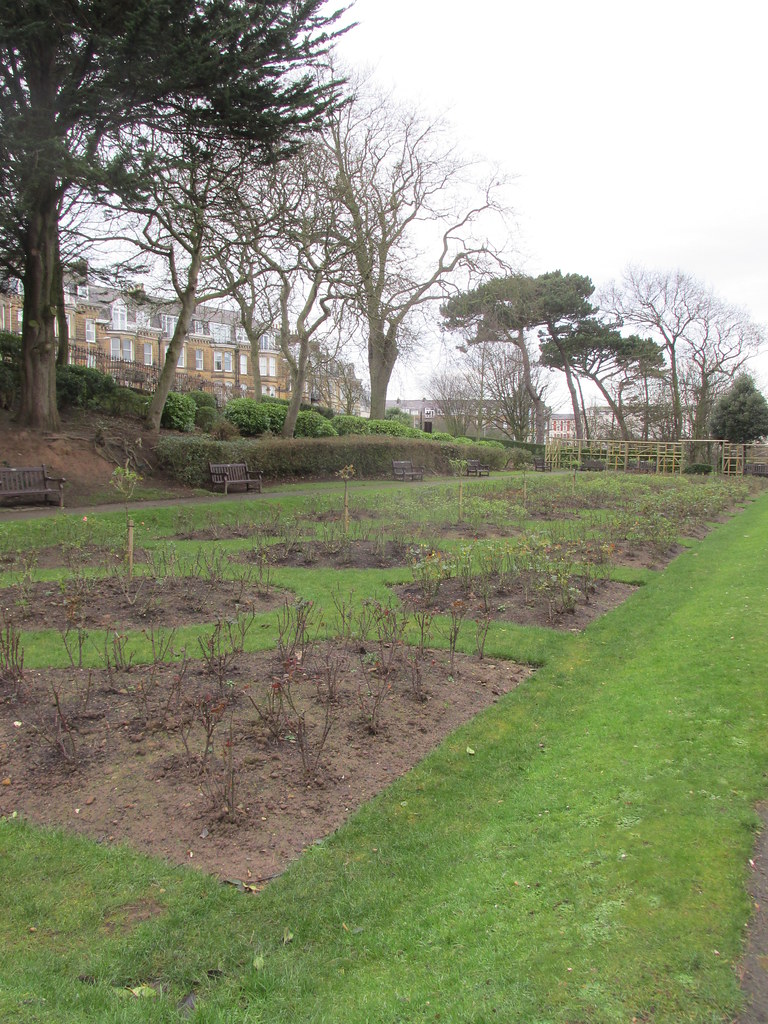
Of course, we visited in January, so we didn't see it at its best; though the lack of foliage meant it was possible to get a clear view of the bedding plan and the layout of the garden.
And more...
Beeforth sold most of his land to Scarborough Corporation in 1912, including the rose garden, and it was opened to the public.
Over the years the garden fell into poor condition. Part of the problem was the shade caused by trees originally planted to shelter the area from sea winds and spray. By 2013 the area was very badly deteriorated and the Friends of South Cliff Gardens applied for a Heritage Lottery Fund grant to restore it.
The work took 15 months, during which drainage was improved, trees were pruned, new topsoil was imported, and 1,100 new rose bushes were planted. The site was officially re-opened last June.
Of course, we visited in January, so we didn't see it at its best; though the lack of foliage meant it was possible to get a clear view of the bedding plan and the layout of the garden.
And more...
Subscribe to:
Posts (Atom)