 |
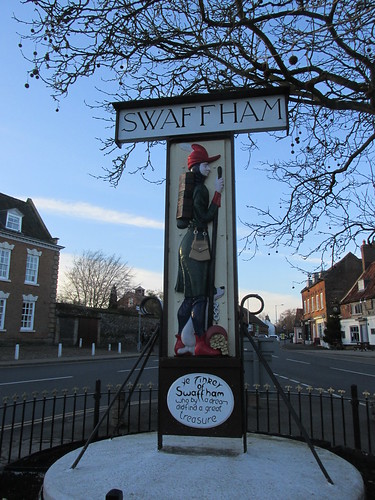
| The village sign |
One of the first ever stories on the children's TV series
Jackanory was a traditional tale from Norfolk, read by actor Lee Montague: The Pedlar of Swaffham. There's a village sign in Swaffham that shows the pedlar, with his dog and his pack, over an inscription that reads:
Ye tinker of Swaffham who by a dream did find great treasure.
The story goes that many years ago a pedlar from the Norfolk market town of Swaffham dreamed that he should travel to London where a man on London Bridge would tell him where to find a buried treasure. The pedlar's name was John Chapman (an old word for pedlar) and he told his family of his dream but they laughed and said he would be wasting his time. But Chapman ignored them and, taking his dog and his pack, set off for the capital.
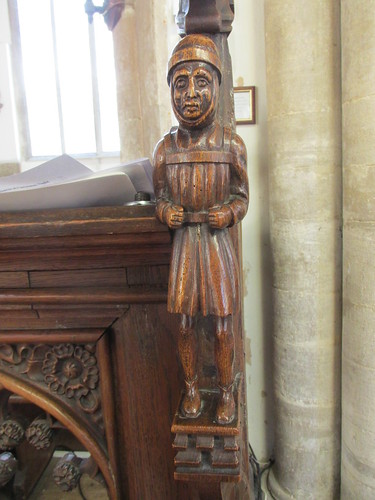 |
| 15th century original |
It took five days to walk to London, and once there he sat for another three days on London Bridge. Eventually a local shopkeeper asked what he wanted. Chapman explained about his dream and the man replied that if he traveled to the town of Swaffham, to the home of the pedlar John Chapman, he would find a treasure buried under a hawthorn tree. So Chapman returned home and dug under the hawthorn tree in his own garden, where he found a pot full of old coins.
He told no-one of his find, and placed the pot among the others in his home. The surface was decorated and had a Latin inscription around it, but the pedlar could not read Latin. Then one day a monk on his way to a pilgrimage in Walsingham told Chapman what it said. The inscription translated as "Where you find me, dig to find another." So Chapman went back into his garden and dug in the same spot, where he found an even bigger pot full of gold coins.
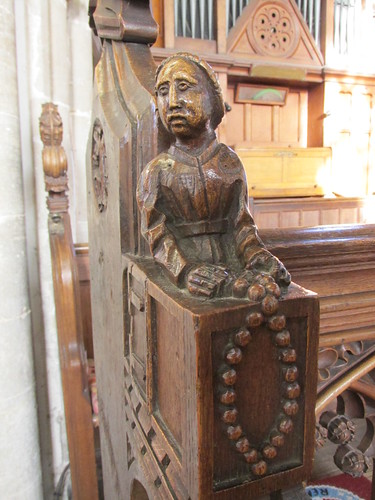 |
| Chapman's wife |
Around the same time the village church collapsed, and all the residents were taxed to pay for a new one. Chapman went to see the builders and asked what the building would cost. Then he agreed to pay for the whole north aisle. The villagers were so grateful that they put stained glass portraits of John, his wife and their three children in the aisle. They also created a family pew for them with carvings of John, his wife and his dog.
Enough money was left over to build the tower and spire.
And now the facts:
There really was a churchwarden called John Chapman who paid a great deal of money towards the church restoration in 1460. Contemporaneous carvings of a pedlar carrying a pack, a dog, and a woman using rosary beads are currently incorporated into the clergy stalls. They are believed to be from the original Chapman family pew. When the Victorians replaced the old-fashioned box pews they put a replica carving of the pedlar on the front row of the new seating.