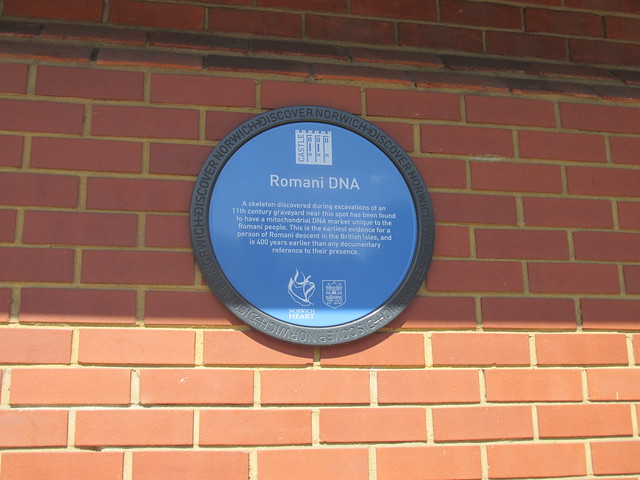
Close by Norwich Castle you'll find a blue plaque which, unlike most of their kind, doesn't actually name the person it commemorates. In fact it marks a new finding about bones that were excavated in the 1990s.
The latest research techniques have allowed archaeologists to isolate DNA from the tooth pulp of a young Saxon man and he was found to possess a genetic marker from the Romani people - the earliest evidence for their presence anywhere in the UK.
The plaque reads:
Romani DNA
A skeleton discovered during excavations of an 11th century graveyard near this spot has been found to have a mitochondrial DNA marker unique to the Romani people. This is the earliest evidence for a person of Romani descent in the British Isles, and is 400 years earlier than any documentary reference to their presence.
Thursday, 30 July 2015
Friday, 24 July 2015
Cow Tower
Cow Tower in Norwich is considered to be one of the finest surviving examples of medieval brickwork in the UK. It stands by a bend in the River Wensum and we discovered it by accident during a post-prandial stroll. If you're ever in the city it's worth checking out the riverside walk because there are several interesting things to spot along the way and I'll be showing you some of them in future posts.
The tower was built as an artillery blockhouse and is one of the earliest examples. It was constructed in 1398-9 to command a strategic point in the city's defences. At the time Britain wasn't very friendly with France. A French raid had devastated Southampton in 1338, and the Peasants' Revolt of 1381 had left Norwich badly damaged. So Cow Tower could serve a dual purpose to protect the city from attacks both inside and out! It would have housed a garrison when necessary.
Norwich was walled (mostly demolished to make way for expansion in the 18th and 19th centuries) and Cow Tower strengthened those defences. It was equipped with hand cannon and bombards (large caliber, muzzle-loading artillery pieces. Gives rise to the title of Bombadier.)
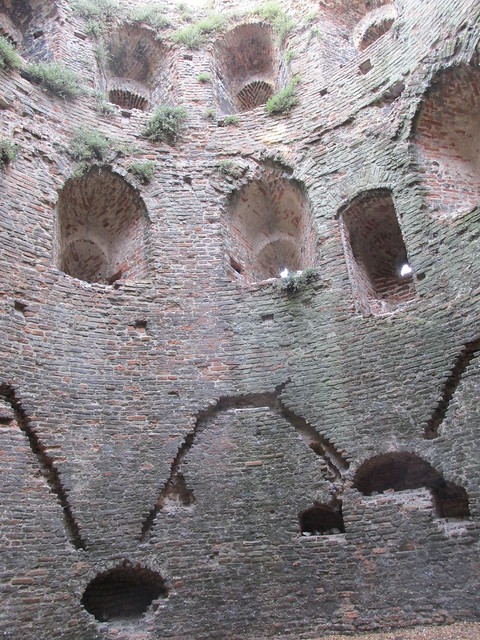
Cow Tower is quite big. It's 14.6 metres (48 ft) high, 11.2 metres (37 ft) across, and the walls are 1.8 metres (5 ft 11 in) thick at the base. The brick facings have the local flint building material in their core.
It had three floors, all now sadly missing, and a staircase up the side to reach them. It takes its name from the surrounding Cowholme area, meaning a water meadow where cows are grazed.
It's now a scheduled monument in the care of English Heritage. You can't go in, but you can see the interior clearly through the original (barred) doorway.
For a detailed review click here.
The tower was built as an artillery blockhouse and is one of the earliest examples. It was constructed in 1398-9 to command a strategic point in the city's defences. At the time Britain wasn't very friendly with France. A French raid had devastated Southampton in 1338, and the Peasants' Revolt of 1381 had left Norwich badly damaged. So Cow Tower could serve a dual purpose to protect the city from attacks both inside and out! It would have housed a garrison when necessary.
Norwich was walled (mostly demolished to make way for expansion in the 18th and 19th centuries) and Cow Tower strengthened those defences. It was equipped with hand cannon and bombards (large caliber, muzzle-loading artillery pieces. Gives rise to the title of Bombadier.)
![]() |
| Cow Tower interior |
It had three floors, all now sadly missing, and a staircase up the side to reach them. It takes its name from the surrounding Cowholme area, meaning a water meadow where cows are grazed.
It's now a scheduled monument in the care of English Heritage. You can't go in, but you can see the interior clearly through the original (barred) doorway.
For a detailed review click here.
Subscribe to:
Posts (Atom)


